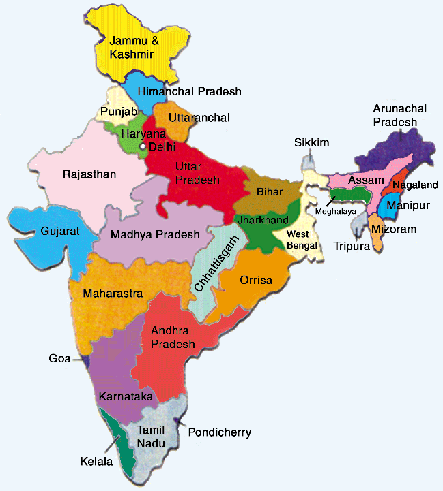
The culture of India refers to the religions, beliefs, customs, traditions, languages, ceremonies, arts, values and the way of life in India and its people. India's languages, religions, dance, music, architecture, food, and customs differ from place to place within the country. Its culture often labeled as an amalgamation of these diverse sub-cultures is spread all over the Indian subcontinent and traditions that are several millennia old.
India officially the Republic of India (Bhārat Gaṇarājya), is a country in South Asia. It is the seventh-largest country by geographical area, the second-most populous country with over 1.2 billion people, and the most populous democracy in the world. Bounded by the Indian Ocean on the south, the Arabian Sea on the south-west, and the Bay of Bengal on the south-east, it shares land borders with Pakistan to the west; China, Nepal, and Bhutan to the north-east; and Burma and Bangladesh to the east.
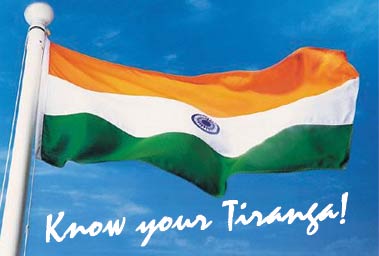
The National flag of India is a horizontal rectangular tricolour of deep saffron, white and India green; with the Ashok Chakra, a 24-spoke wheel, in navy blue at its centre. It was adopted in its present form during a meeting of the Constituent Assembly held on 22 July 1947, when it became the official flag of the Dominion of India. The flag was subsequently retained as that of the Republic of India. In India, the term "tricolour" (Hindi: तिरंगा, Tirangā) almost always refers to the Indian national flag. The flag is based on the Swaraj flag, a flag of the Indian National Congress designed by Pingali Venkayya.
